
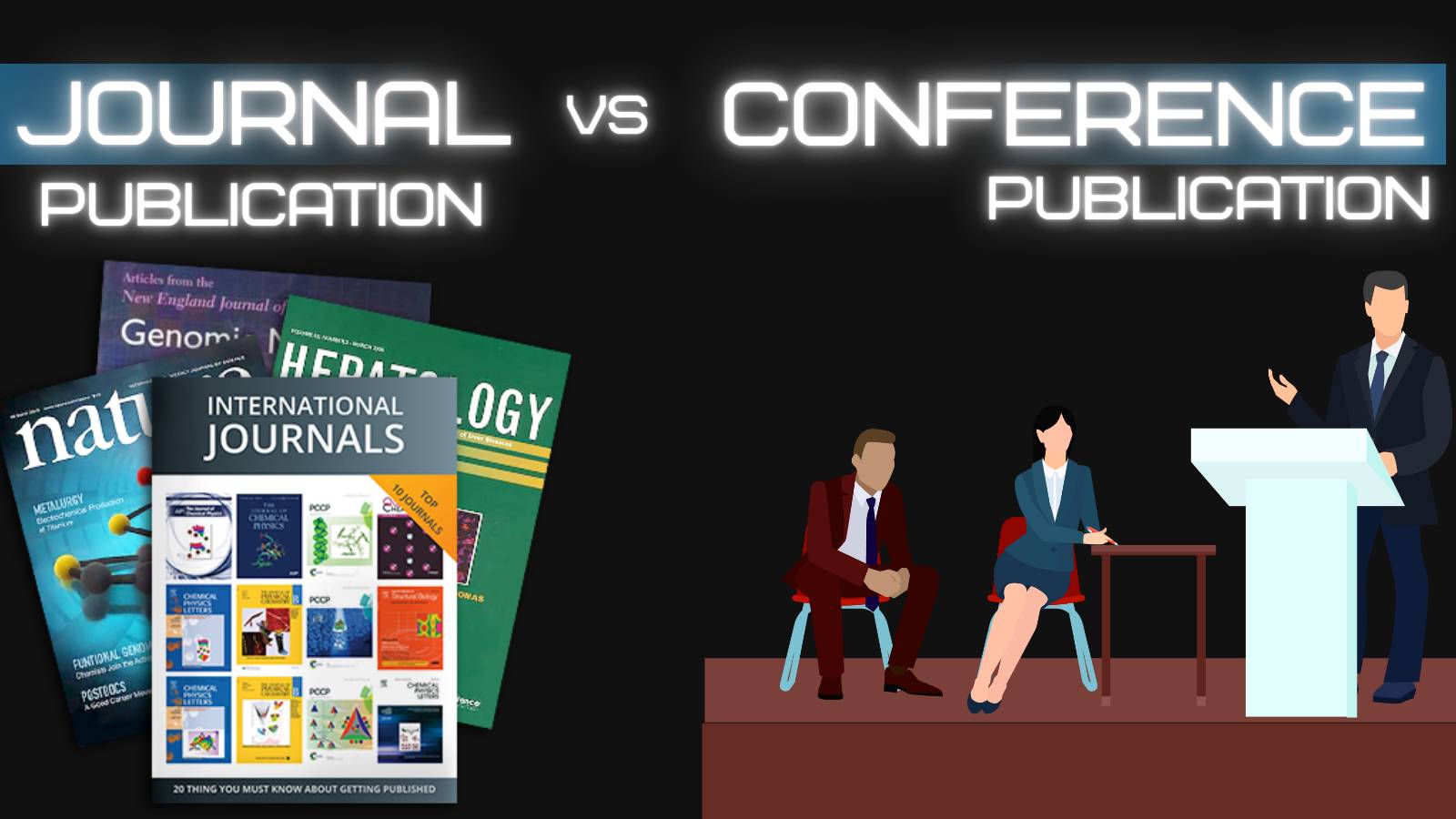
Journal vs Conference Publication is an important comparison in Academic research that helps scholars understand where and how to publish their work effectively. Both formats differ in review process, depth, and publication timeline, which directly affects research visibility and career growth.
Understanding the differences between journal and conference publications helps researchers choose the right platform for their work, improve their publication strategy, and align their efforts with academic or career goals. Below, provides a clear, structured comparison along with key features, advantages, and conversion practices to help you make an informed decision.
What is Journal Publication?
A journal publication is a detailed, peer-reviewed research article published in academic journals after strict evaluation by experts in the field. Journals are considered highly credible because they require strong originality and deep research contribution.
Key Features of Journal Publication
- Peer-reviewed by domain experts
- High research depth and detailed analysis
- Published in indexed databases like Scopus, Web of Science, IEEE, Springer
- Longer review and publication time
- High academic credibility
What is Conference Publication?
A conference publication is a research paper presented and published in academic Conference Proceedings. It is often used to share new ideas, early-stage research, or innovative concepts with the academic community.
Key Features of Conference Publication
- Faster publication compared to journals
- Presented in live academic conferences
- Published in IEEE, ACM, Springer proceedings
- Often shorter and more focused papers
- Includes presentations or poster sessions
Journal vs Conference Publication – Key Differences
Understanding the difference between journal and conference publications is important for students, researchers, and professionals planning their academic or career path. Below find the key differences between both formats to help you clearly decide which one fits your research goals better.
| Aspect | Journal Publication | Conference Publication |
|---|---|---|
| Time to get published | Slow (can take 6–18 months or more depending on revisions) | Fast (often 1–3 months, sometimes even quicker deadlines) |
| Acceptance difficulty | Very high (strict rejection rate, multiple review rounds) | Moderate to high (easier in many conferences, but top ones are very competitive) |
| Paper length allowed | Long (detailed 10–30+ pages possible) | Short (typically 4–10 pages, strict page limits) |
| Level of detail expected | Very deep (full experiments, proofs, extended results required) | Limited depth (focus on key idea + main results only) |
| Chance of revision after review | Multiple revisions usually allowed | Limited or no major revision (often accept/reject) |
| Publication visibility speed | Slow visibility (appears after long review cycle) | Quick visibility (published in proceedings soon after acceptance) |
| Career impact (academic) | Higher weight for PhD, faculty, and research roles | Useful but generally secondary to journals in academia |
| Industry recognition | Strong but indirect impact | Strong immediate recognition, especially in tech fields |
| Presentation requirement | Not required | Usually mandatory (oral/poster/demo) |
| Networking opportunity | Minimal direct interaction | Strong networking with researchers and industry experts |
| Indexing consistency | Mostly well-indexed (Scopus, SCI, IEEE, Springer journals) | Varies widely (some indexed, some not indexed at all) |
| Rejection rate predictability | High and less predictable | More predictable but varies by conference tier |
| Best for publishing | Final, polished, complete research work | New ideas, early results, prototypes, or ongoing research |
Advantages of Journal Publication
Journal publications are highly valued in academia because they represent well-validated and thoroughly reviewed research work. They are widely recognized across universities and research institutions for their credibility and long-term impact.
- Higher academic recognition
- Better long-term citation value
- Strong impact in PhD and research careers
- Global acceptance in universities
Advantages of Conference Publication
Conference publications help researchers share their ideas quickly and gain early visibility in the academic and professional community. They also provide valuable opportunities for presentation and direct interaction with experts for feedback and improvement.
- Fast publication process
- Early research exposure
- Opportunity for live presentation
- Direct feedback from experts
Can Conference Papers Be Converted into Journal Papers?
Conference papers can often be extended and transformed into journal publications by adding substantial improvements and deeper analysis. This process helps researchers refine their initial findings and present a more complete and high-quality version of their work.
How Conversion Works
Researchers enhance the depth, scope, and quality of the original work when they convert a conference paper into a journal paper.
- Researchers add detailed experiments to strengthen the study.
- They improve methodology and analysis for higher accuracy.
- They expand results and discussion to provide deeper insights.
- They revise original content to avoid duplication issues.
Common Practice
Researchers in fields like computer science and engineering widely follow this practice to publish extended versions of their work.
- Researchers extend IEEE/ACM conference papers into journal publications.
- Academic communities widely accept this conversion approach.
A balanced approach—starting with conferences and later publishing in journals—helps researchers build a strong and successful academic profile.
FAQs
Is conference publication equal to journal publication?
No, journals generally have higher academic value due to deeper review and stronger research requirements.
Which is better for PhD admission?
Journals are preferred, but good conference papers also strengthen your profile.
Can I publish both journal and conference papers?
Yes, many researchers first publish conferences and later extend them into journals.
Do conferences have less value than journals?
Not always — top conferences in AI, ML, and CS can be highly prestigious.