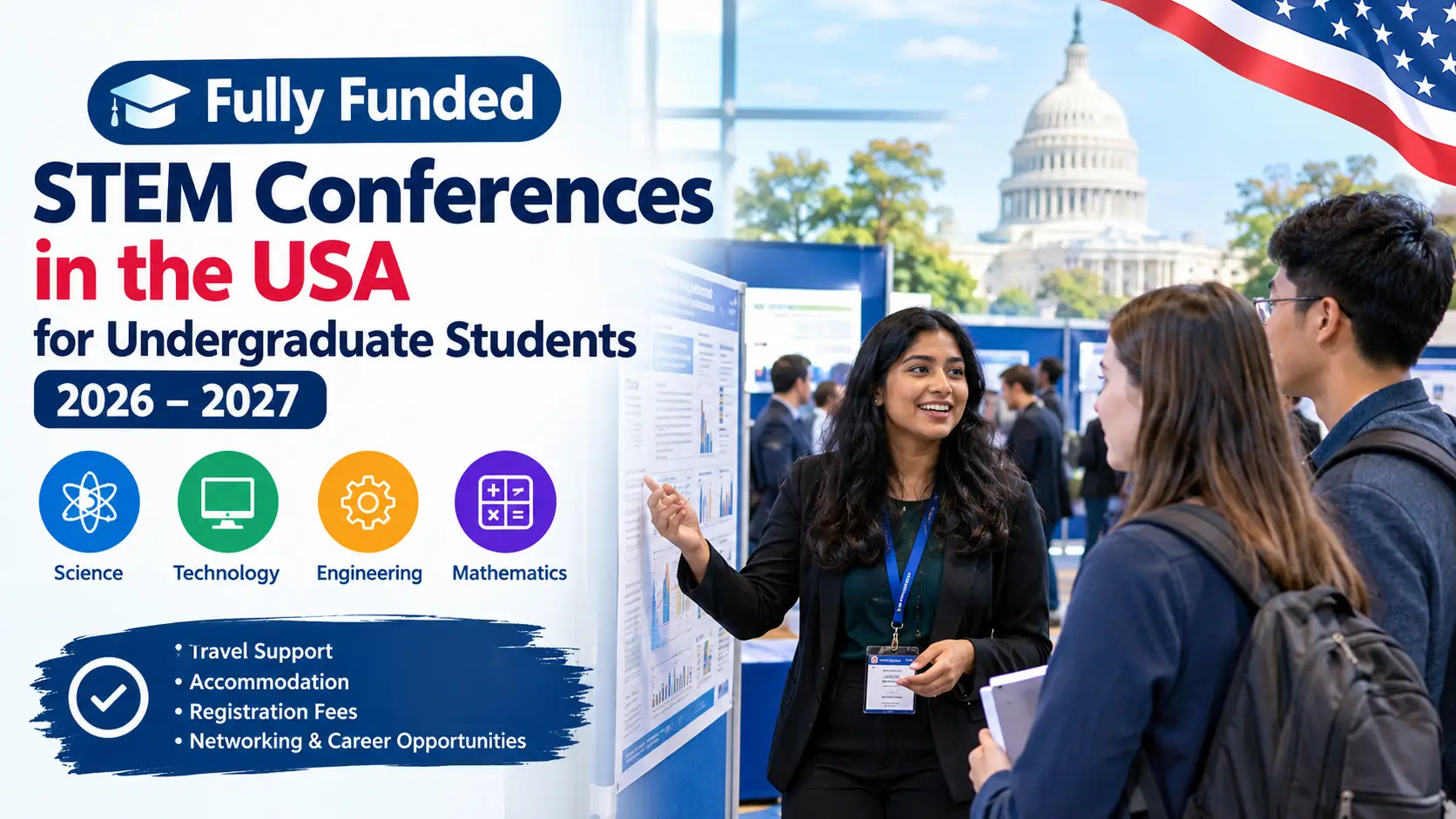
For undergraduate students studying science, technology, engineering, or mathematics (STEM), attending a conference can be a valuable opportunity to learn about new research, meet experts, present projects, and explore career opportunities. However, attending conferences in the United States can be expensive due to registration fees, airfare, accommodation, and other travel costs.
Fully funded STEM conferences help reduce these financial barriers by offering selected students support for expenses such as registration, travel, accommodation, and meals. Some programs also provide research presentation opportunities, mentoring, workshops, and networking sessions.
Below explores upcoming fully funded STEM Conferences in the USA in 2026–2027, including what are fully funded STEM Conference, benefits & how to apply it.
What Are Fully Funded STEM Conferences?
Fully funded STEM conferences are academic or professional events where organizers, universities, scientific associations, research institutions, foundations, or sponsors cover eligible expenses for selected participants. These conferences focus on science, technology, engineering, mathematics, or interdisciplinary subjects.
Unlike ordinary conferences, where participants usually pay their own expenses, funded programs help students attend without bearing all the approved costs themselves. The term fully funded requires careful attention. Some programs cover registration, travel, and accommodation, while others cover only selected expenses. Some scholarships reimburse students after the event, while other programs arrange flights and hotels directly. Students should always review the official funding terms to understand which expenses the program covers.
Benefits of Attending STEM Conferences in the USA as an Undergraduate
STEM conferences give undergraduate students opportunities to explore scientific developments, connect with experts, and learn about careers beyond the classroom. They also help students discover research interests, develop professional skills, and prepare for future academic or career opportunities.
Networking With Researchers, Professors, and Industry Experts
Conferences allow students to meet researchers, professors, scientists, engineers, and technology professionals. These connections can help them discover research projects, internships, graduate programs, and potential career paths. Students can build professional relationships by asking questions after presentations, discussing research posters, and participating in networking sessions.
Presenting Research Papers and Academic Projects
Many STEM conferences allow undergraduates to present research through posters, oral presentations, or technical demonstrations. These activities help students communicate complex ideas, answer questions, and receive feedback from experienced researchers. However, some funded programs require research presentations, while others welcome students who attend primarily to learn and network. Applicants should check the conference requirements before applying.
Exploring Graduate School and Research Opportunities
Conferences help students explore master’s programs, doctoral studies, and research careers. Conversations with faculty members and graduate students can provide insights into laboratory opportunities, research funding, and graduate school requirements. These experiences help students identify programs that match their academic interests and plan their next steps.
Building Skills and Strengthening Your Academic CV
Conference participation can help students develop communication, critical thinking, presentation, and collaboration skills. Depending on their involvement, they can also highlight research presentations, workshops, and relevant conference activities on their CV. Students should accurately describe their participation and distinguish conference attendance from research publications or awards.
Connecting With Internship and Career Opportunities
Some STEM conferences offer career fairs, employer presentations, recruitment sessions, and industry workshops. These activities help students understand employer expectations and explore opportunities in fields such as engineering, biotechnology, data science, and artificial intelligence. Students can prepare by updating their CV, reviewing the event schedule, and identifying organizations or professionals they want to meet.
Upcoming Fully Funded STEM Conferences in the USA in 2026–2027
Students should check conference dates, abstract deadlines, and funding deadlines separately because organizers often close scholarship applications before the event begins. The following opportunities offer research, networking, and potential financial support for undergraduate students.
1. SACNAS National Diversity in STEM Conference 2026–2027
- Dates: October 29–31, 2026
- Location: Long Beach, California
- Dates: October 28–30, 2027, in Kansas City, Missouri
- More Details visit.
The SACNAS Annual Conference brings together STEM students, researchers, and professionals for research presentations, career development, and networking. Selected undergraduate students can receive travel scholarships covering travel, shared lodging, and/or registration. Applications for the 2026 scholarships have closed.
2. National Conference on Undergraduate Research (NCUR) 2027
- Dates: April 12–14, 2027
- Location: Grand Rapids, Michigan
- More details visit.
The NCUR 2027 welcomes undergraduate research across scientific and academic disciplines. Students can present their research and explore academic and professional opportunities. Some universities offer travel grants covering airfare, accommodation, and registration for selected students. The abstract submission deadline is December 4, 2026.
3. American Meteorological Society (AMS) Annual Meeting 2027
- Dates: January 10–14, 2027
- Location: Denver, Colorado
- Field: Weather, climate, and atmospheric science
- For details visit.
The AMS Annual Meeting features scientific presentations and professional development in atmospheric and environmental sciences. Students can investigate travel assistance and student funding opportunities.
4. American Chemical Society (ACS) Spring Meeting 2027
- Dates: March 21–25, 2027
- Location: New Orleans, Louisiana
- Field: Chemistry and related sciences
- For more information visit.
The ACS Spring Meeting offers research presentations, technical sessions, and networking opportunities. The ACS Bridge Travel and Professional Development Award provides up to $1,000 toward eligible expenses for selected students. Applications open December 8, 2026, and close January 13, 2027. Eligibility restrictions apply, including requirements for students in the chemical sciences.
5. Emerging Researchers National (ERN) Conference in STEM 2027
- Dates: March 4–6, 2027
- Location: Atlanta, Georgia
- Field: Multiple STEM disciplines
- For more information visit.
The ERN Conference supports emerging researchers through scientific presentations, networking, and professional development. The organizers offered travel awards for the 2027 conference, but applications closed on September 7, 2026. Students should monitor the official website for future funding opportunities.
How to Apply for Fully Funded STEM Conferences in the USA
Applying for a funded conference opportunity usually involves more than completing a registration form. Students may need to submit a separate scholarship application, prepare supporting documents, obtain a recommendation, and meet a research abstract deadline. A well-organized application process helps students avoid missing important requirements and gives them time to improve the quality of their submissions. Below are steps to apply:
Step 1: Find a Relevant STEM Conference
Search official conference websites, scientific societies, and university research pages for events related to your field. Compare conference dates, eligibility requirements, funding options, and application deadlines.
Step 2: Check Funding and Eligibility Requirements
Confirm that undergraduate students can apply and check whether international students qualify. Review which expenses the award covers, such as registration, travel, accommodation, or meals. Also, determine whether you need to submit a research abstract before applying for funding.
Step 3: Prepare Your Academic CV
Highlight your degree program, relevant coursework, research projects, technical skills, internships, presentations, and academic achievements. Keep your CV clear, concise, and relevant to the conference.
Step 4: Write a Strong Statement of Purpose
Explain why you want to attend, how the conference relates to your academic interests, and what you hope to learn. If you need financial assistance, briefly explain how funding would help you participate.
Step 5: Submit a Research Abstract if Required
Summarize your research objectives, methods, findings, and significance within the conference’s word limit. Follow the submission guidelines and present your work accurately. If you do not have research to present, look for programs that support attendees without presentations.
Step 6: Complete the Funding Application
Submit the scholarship or travel grant application separately if required. Include all requested documents, such as transcripts, proof of enrollment, recommendation letters, or research abstracts. Check every requirement before submitting.
Step 7: Track Your Application and Funding Decision
Monitor your email and application portal for updates. If selected, review the award conditions and confirm how the organizers handle travel bookings, accommodation, payments, or reimbursements before making arrangements.
Choosing the right STEM conference can help undergraduate students gain practical knowledge, share their ideas, and build valuable academic connections. Before applying, compare available funding options, confirm eligibility requirements, and keep track of upcoming deadlines. Start exploring verified conference opportunities early to find an event that aligns with your research interests and future goals.