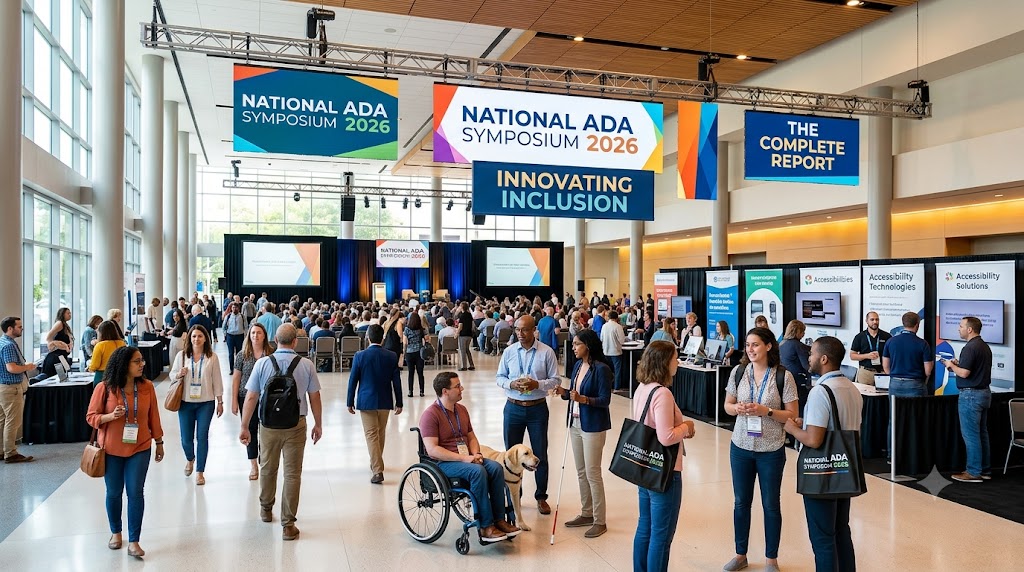
For over a quarter of a century, the National ADA Symposium has served as the definitive compass for accessibility compliance, inclusive design, and disability rights in the United States. Spanning its highly attended virtual gathering and its signature in-person event at the Desert Ridge Resort in Phoenix, Arizona, the 2026 iteration marked a critical tipping point.
We aren’t just talking about fixing cracked sidewalks or updating building codes anymore. This year, the conversation shifted radically toward digital landscapes, artificial intelligence (AI) accountability, neuroinclusive design, and the evolving structural frameworks of modern organizations.
If you couldn’t make it to the desert this year, don’t worry. Here is your complete, unfiltered breakdown of the sessions, trends, and future predictions that came out of the 2026 Symposium.
The Keynote & Core Sessions Summary
The energy of the event was anchored by opening keynote speaker Andy Imparato, CEO of Disability Rights California. Imparato, drawing on over 30 years of policy experience and his own lived experience with bipolar disorder, set an urgent tone: true accessibility requires looking beyond mere legal check-boxes and moving toward systemic institutional change.
Across more than 80 specialized sessions featuring officials from the U.S. Access Board, the EEOC, and the Department of Justice, the core curriculum focused heavily on enforcement realities and emerging adaptations:
- Title II and Title III Re-Evaluations: Federal presenters gave clear guidance on navigating the tightening state, local, and commercial compliance requirements. The message was clear—proactive self-evaluation beats a DOJ investigation every single time.
- Operationalizing Healthcare & Emergency Preparedness: Multiple sessions broke down the logistics of maintaining effective communication and accessibility under pressure, particularly during localized climate crises and public health events.
- The Physical-Digital Blend: Sessions led by technical experts highlighted the rapid evolution of hybrid infrastructure—such as accessible EV charging stations and smart public transit hubs—proving that physical spaces must now interact flawlessly with digital software.
Top 3 Macro Trends Shaping Accessibility
The hallways and virtual chat rooms of the 2026 Symposium weren’t just debating old standards; they were mapping out three massive structural shifts:
Trend A: Neuroinclusive Design Goes Mainstream
Accessibility has historically focused heavily on mobility, vision, and hearing. The breakout trend of 2026 is neuroinclusive design. Discussions heavily detailed how sensory-responsive accessibility must be factored into workplaces and public environments—altering lighting, acoustic dampening, and spatial layouts to accommodate neurodivergent individuals.
Trend B: Higher Education & Global Human Rights Alignment
A fascinating cross-border trend emerged regarding how legal frameworks are evolving across the academic year. Institutions are increasingly viewing accessibility not merely through the strict civil rights lens of the standard ADA paradigm, but rather through the holistic human rights framework of the global Convention on the Rights of Persons with Disabilities (CRPD). This is radically changing how universities design digital curricula and physical campus landscapes globally.
Trend C: The Rise of AI-Assisted Mobile Compliance
The integration of automated accessibility mapping tools took center stage. Compliance teams are shifting away from slow, annual manual audits and moving toward “Living Transition Plans” driven by desktop virtual street evaluations and mobile field-inspection applications that flag barrier remediation needs in real-time.
Key Insights: Breaking Down the Data
If there is one foundational takeaway from this year’s symposium, it is that compliance cannot exist without rigorous, data-driven methodology. To understand how we build truly inclusive systems, we must first step back and ask: what is research if not the systematic pursuit of tracking human barriers and eliminating them?
Modern inclusion strategies require looking at behavioral data, edge-case user testing, and advanced communication modeling. For instance, in fields studying speech processing and assistive vocal technologies—frequently showcased at global forums like interspeech—the data shows that speech-to-text algorithms still carry massive accuracy gaps for individuals with atypical speech patterns.
True inclusion means adjusting our engineering pipelines based on that research, rather than waiting for a regulatory body to force our hand.
Future Predictions: What to Expect Next
Based on the legal updates and technological prototypes showcased at the symposium, here is where accessibility is heading by the end of the decade:
- Algorithm Accountability Laws: Expect the DOJ and EEOC to crack down heavily on biased, inaccessible AI hiring tools. Built-in digital barriers will soon face the same legal penalties as a building without a ramp.
- The Death of Static Transition Plans: The traditional, dusty PDF compliance report is dead. Private and public organizations will fully transition to cloud-based, dynamic dashboards that track real-time physical and digital remediation progress.
- Universal Design by Default: Tech startups and architectural firms will increasingly adopt universal design from day one, recognizing that building accessibility natively into a product or space is significantly cheaper than retrofitting it later due to litigation.
The Bottom Line: The 2026 National ADA Symposium proved that accessibility is no longer a niche legal specialty tucked away in HR or facilities management. It is a core driver of modern technological innovation, organizational culture, and global human rights.