
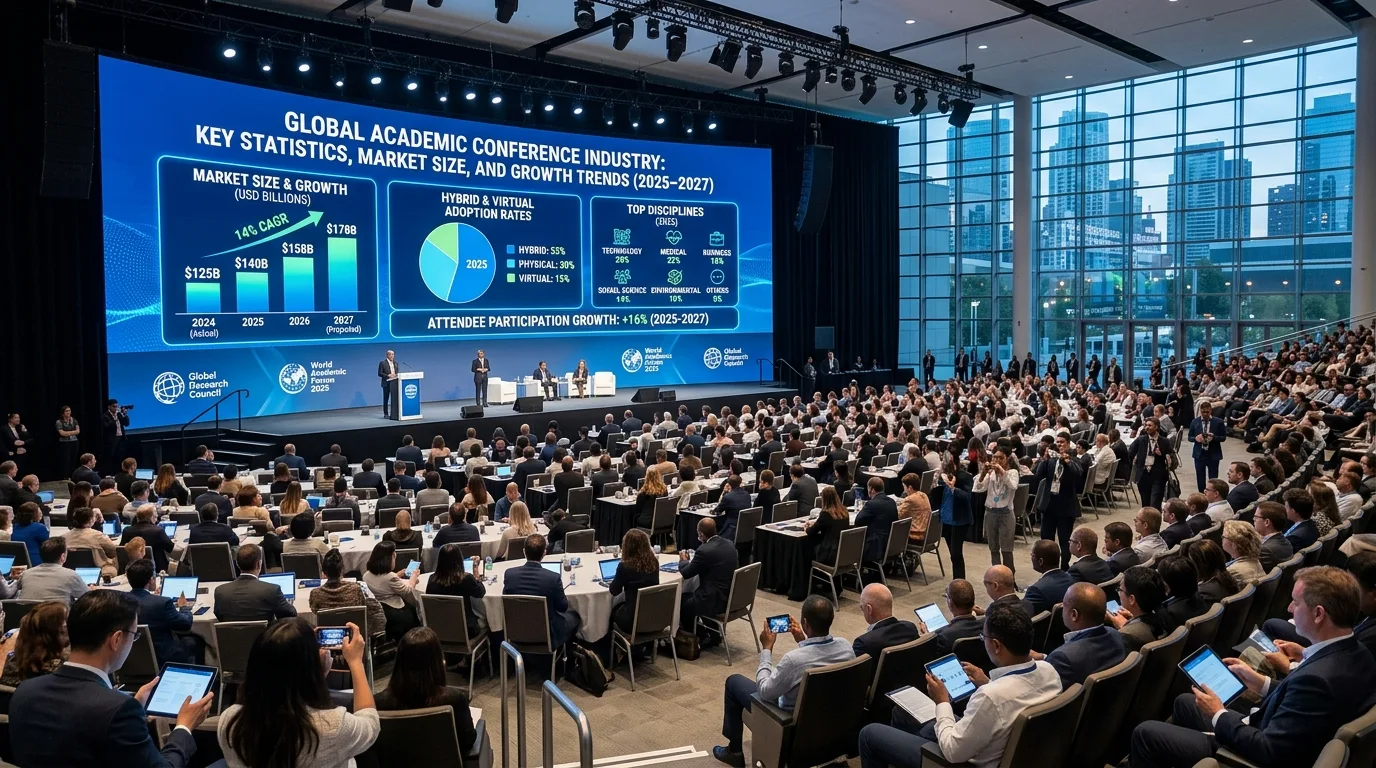
The global Academic conference industry is undergoing rapid transformation, driven by digital adoption, globalization of research, and increasing demand for knowledge exchange. Universities, researchers, and professionals prioritize networking and collaboration, conferences have become a critical pillar of the global knowledge economy. As we move into 2026–2027, several key trends are influencing the growth and transformation of academic conferences worldwide.
Our report highlights the latest data, statistics, and market insights shaping the academic conference ecosystem between 2025 and 2027.
Market Size & Growth Overview
- Estimated global academic conference market size (2024): $1.2–1.5 billion
- Projected market size by 2027: $2.1 billion+
- Expected CAGR (2026–2027): 15–18%
Key Growth Drivers:
- Increased research funding worldwide
- Rise in international collaborations
- Growth of interdisciplinary studies
- Expansion of virtual and hybrid event models
Volume of Academic Conferences (Global Data)
| Year | Estimated Number of Conferences | Growth Rate |
|---|---|---|
| 2022 | 95,000+ | — |
| 2023 | 110,000+ | +15% |
| 2024 | 130,000+ | +18% |
| 2025 | 155,000+ (projected) | +19% |
| 2027 | 200,000+ (projected) | +18% CAGR |
Discipline-Wise Distribution
Academic conferences are spread across multiple domains, reflecting a diverse global research landscape:
- Engineering & Technology (28%): Continues to lead the academic space, driven by rapid advancements in computing, automation, and infrastructure.
- Medical & Health Sciences (22%): Remains a major cornerstone of global research, focusing heavily on clinical breakthroughs, patient care, and global health initiatives.
- Business & Economics (18%): Attracts significant participation as researchers and industry leaders address evolving market dynamics, financial models, and corporate strategy.
- Social Sciences (14%): Plays a crucial role in exploring societal shifts, cultural developments, human behavior, and policy-making.
- Environmental & Sustainability Studies (10%): Represents a highly active and urgent field dedicated to climate action, green technology, and resource conservation.
- Others (8%): Comprises specialized niche areas, interdisciplinary studies, and emerging academic fields.
Trend Insight: While foundational fields maintain the largest market share, conferences centered on artificial intelligence, sustainability, and healthcare innovation are experiencing the fastest year-over-year growth. This shift highlights a growing academic and industry focus on solving immediate global challenges through technological integration.
Geographic Distribution
Top regions hosting academic conferences Asia-Pacific highest & Latin America is lowest:
- Asia-Pacific (35%): Leads the global market as the most active and fastest-growing region, fueled by massive educational investments and a surging volume of scientific research.
- Europe (27%): Retains its status as a premier research destination, leveraging deep-rooted academic traditions and highly accessible, historic host cities.
- North America (22%): Serves as a major powerhouse for high-impact research, driven by world-class universities, major tech hubs, and extensive industry-academic partnerships.
- Middle East & Africa (10%): Shows steady, promising growth as regional governments actively invest in knowledge-based economies and modern academic infrastructure.
- Latin America (6%): Represents a developing sector with a focus on regional collaboration, ecological research, and expanding its academic outreach.
Trend Insight: While traditional powerhouses in Europe and North America remain highly influential, emerging economies like India, the UAE, and Indonesia are rapidly transforming into major International conference hubs, offering state-of-the-art venues and attracting global talent.
Hybrid & Virtual Conference Adoption
The format of academic gatherings has evolved rapidly over recent years, shifting from traditional in-person models to highly flexible digital frameworks:
- 2020 (15% Virtual Adoption): Marked the initial, sudden pivot to digital platforms, driven by necessity as global travel came to an abrupt halt.
- 2023 (48% Hybrid/Virtual): Reflected a stabilizing market where organizers recognized the long-term value of digital access, cementing hybrid events as a standard industry practice.
- 2025 (65%+ Hybrid Integration): Represents the modern baseline, where the vast majority of international conferences seamlessly blend physical venues with robust digital streaming to maximize reach.
Key Benefits Driving Adoption
The sustained shift toward hybrid models is propelled by several distinct advantages for both organizers and attendees:
- Increased Global Participation: Breaks down geographical barriers, allowing researchers from all corners of the world to present their work and collaborate without borders.
- Lower Travel Costs: Minimizes the financial burden on university budgets and independent researchers by eliminating the need for expensive flights and lodging.
- Improved Accessibility: Opens doors for individuals with physical disabilities, health concerns, or visa restrictions, ensuring a more inclusive and diverse academic discourse.
Attendee Trends & Behavior
The expectations, demographics, and formatting preferences of academic event participants are undergoing a significant transformation:
- Average Conference Scale (150–500 Participants): Represents the sweet spot for modern academic events. This scale is ideal for fostering high-quality networking, maintaining focused track sessions, and managing logistics efficiently.
- International Participation (+25% Growth Since 2022): Driven largely by digital accessibility, global collaboration has surged, bringing a much more diverse, cross-border perspective to academic discussions.
- Early-Career Researcher Participation (+30% Increase): Lower financial and geographic barriers have allowed graduate students, postdocs, and junior faculty—who traditionally faced strict budget constraints—to participate in global discourse at unprecedented rates.
Preferred Formats
When it comes to how attendees actually want to consume academic content, flexibility is the defining factor:
- Hybrid (52% Preference): The clear majority choice. Attendees highly value having the “best of both worlds”—the option to travel for key milestones while retaining the flexibility to tune in digitally when schedule or budget dictates.
- In-Person (33% Preference): A dedicated portion of the academic community still strongly favors physical attendance, prioritizing face-to-face networking, spontaneous collaborations, and immersive workshop environments.
- Fully Virtual (15% Preference): A smaller but highly focused segment prefers entirely online events, valuing the absolute convenience, zero-travel requirements, and highly efficient, asynchronous access to research findings.
Economic Impact
Academic conferences do far more than just facilitate the exchange of ideas; they serve as powerful catalysts for both local and global financial growth. By drawing thousands of international visitors to host cities, these events inject significant revenue into local markets and support millions of jobs worldwide. This continuous influx of travel, lodging, and commerce establishes academic hosting as a vital economic pillar:
- Annual Global Economic Impact ($10+ Billion): Represents a massive global footprint driven directly by registration fees, academic sponsorships, venue bookings, and attendee travel.
- Average Spending per Attendee ($800–$2,500): Reflects the high premium of academic travel, with participants investing heavily in flights, local transit, dining, and accommodations during their stay.
Key Sectors Benefiting
The financial ripple effect of a major conference extends deep into the host city’s infrastructure, directly boosting several key industries:
- Hotels & Tourism: Benefits from high-volume, multi-day room bookings and extended leisure stays, significantly raising local hospitality revenue.
- Airlines & Transportation: Experiences a surge in bookings as international delegates rely on flights, trains, rideshares, and public transit to commute.
- Local Businesses: Sees a direct increase in foot traffic and sales, particularly across neighborhood restaurants, cafes, retail shops, and local cultural attractions.
Future Outlook (2025–2027)
The academic conference landscape is undergoing a massive transformation, driven by emerging technologies and shifting global priorities. Over the next few years, traditional event hosting will continue to transition into a highly efficient, tech-enabled, and ecologically conscious ecosystem. These advancements are set to redefine how research is shared, networking is conducted, and global academic communities collaborate:
1. AI Integration
The integration of Artificial Intelligence is moving from experimental use cases to a mainstream operational standard:
- Smart Matchmaking Between Attendees: Advanced algorithms analyze participants’ research profiles, published papers, and current projects to suggest highly compatible peers and potential collaborators.
- Automated Scheduling & Recommendations: AI tools dynamically generate personalized itineraries for attendees, recommending specific tracks, workshops, and panel sessions tailored to their unique academic interests.
2. Sustainability Focus
Environmental accountability is becoming a non-negotiable metric for modern academic institutions and planning committees:
- Carbon-Neutral Events: Organizers are actively tracking and offsetting carbon emissions from attendee travel, utilizing local sourcing, and implementing paperless operations.
- Reduced Physical Footprint: By optimizing hybrid setups, conferences are drastically cutting down on physical waste, single-use materials, and heavy resource consumption at venues.
3. Niche Conferences Growth
The era of massive, generalized academic conventions is gradually sharing the stage with more agile, targeted gatherings:
- Specialized Micro-Events in Emerging Fields: Small-scale, highly focused “micro-conferences” are rising in popularity. These events allow researchers in ultra-specific, rapidly evolving niches (such as quantum computing ethics or hyper-local climate modeling) to deeply collaborate without the noise of a broader summit.
4. Stronger Global Collaboration
Digital frameworks are fostering a more equitable, boundaryless environment for scientific and sociological progress:
- Cross-Border Academic Partnerships: With geography no longer acting as a barrier, co-authored studies and international research consortiums are experiencing rapid growth, seamlessly bridging the gap between institutions in developed and emerging economies.
Summary
The academic conference industry is entering a high-growth phase, fueled by digital transformation and increasing global collaboration. With an expected 18% growth rate by 2027, the sector presents significant opportunities for organizers, researchers, and platforms alike.
As demand continues to rise, platforms that simplify discovery and participation will play a central role in shaping the future of academic networking.