
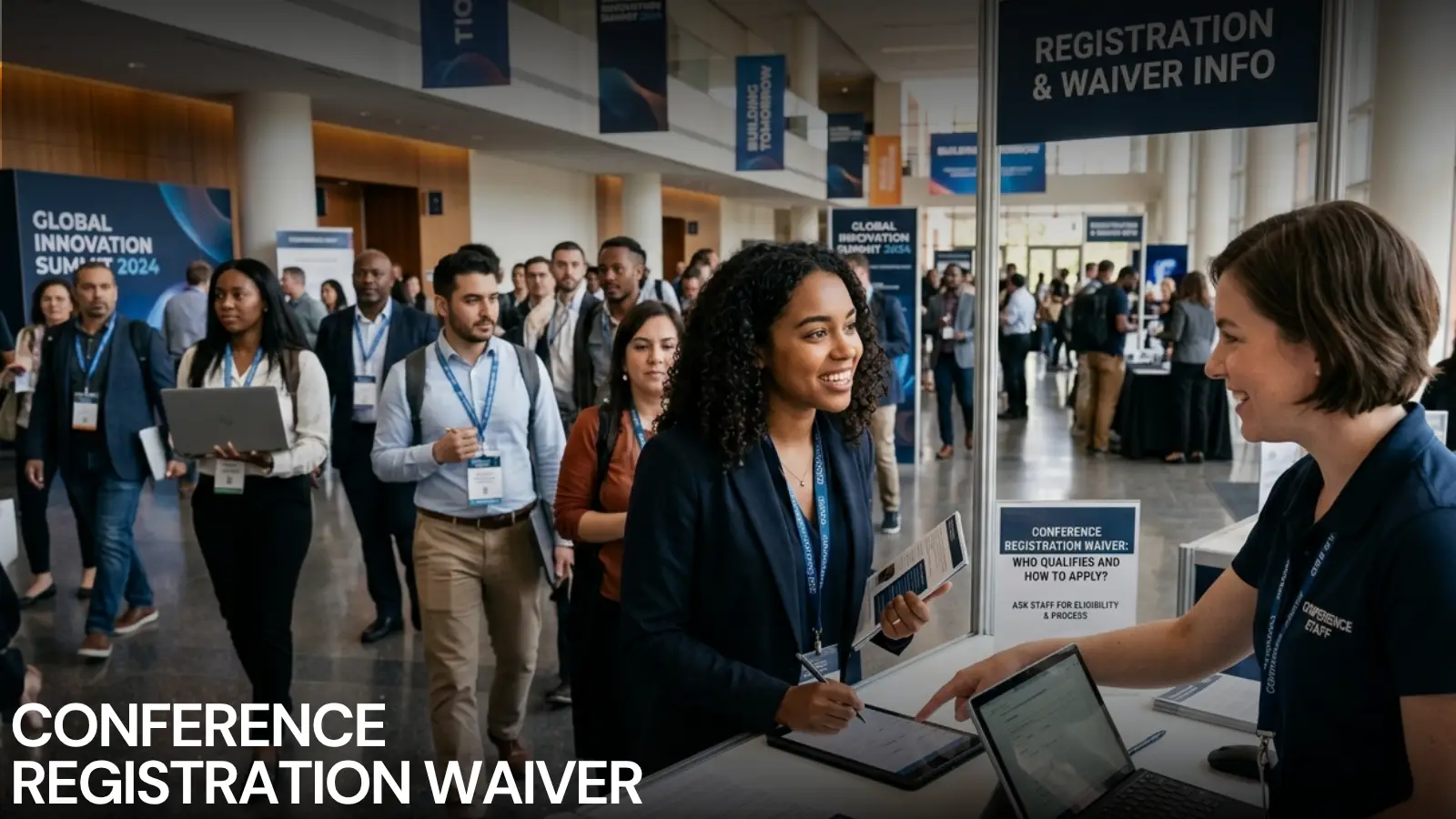
Conference Registration Waiver can make academic and professional conferences more accessible to students, researchers, and other participants facing financial limitations. Depending on the organizer, a waiver may completely remove or partially reduce the registration fee. However, eligibility, required documents, application deadlines, and covered expenses vary between conferences. Below find details on who qualifies, what a waiver covers, the documents you may need, and how to apply successfully.
What Is a Conference Registration Waiver?
A conference registration waiver is a form of financial assistance that allows an eligible participant to attend a conference without paying the full registration fee. Depending on the conference, the organizer may completely remove the registration charge or reduce it by a specific percentage.
A waiver normally applies only to the registration cost and does not automatically cover airfare, accommodation, visa expenses, or other travel costs. Participants should carefully review the official conference policy to understand exactly what the waiver includes.
Who Qualifies for a Conference Registration Waiver?
Conference registration waivers usually target participants who face financial barriers or fall within priority groups. Eligibility varies by conference, but students, researchers, international participants, and those with limited funding commonly qualify.
Students and PhD Scholars
Students and PhD scholars may qualify because they often have limited funding. Conferences may ask for a student ID, enrollment proof, or accepted paper as part of the application.
Early-Career Researchers
Early-career researchers with limited research funding may receive registration support. Conferences may define eligibility based on years of experience, Academic position, or time since completing a PhD.
Researchers Facing Financial Difficulties
Researchers who cannot secure institutional or grant funding may apply based on financial need. Applicants may need to explain their situation and provide supporting documents if required.
International Participants
Some conferences offer waivers to international researchers and students to encourage global participation. However, eligibility may depend on nationality, residence, affiliation, or financial circumstances.
Participants From Developing Countries
Researchers from developing or lower-income countries may receive financial assistance to reduce participation barriers. Check the conference’s official eligibility list because criteria can vary.
Authors With Accepted Papers
Authors with an accepted paper, abstract, poster, or presentation may qualify for certain waiver programs. However, acceptance alone does not guarantee a waiver, as additional eligibility conditions may apply.
What Are the Eligibility Requirements for a Conference Fee Waiver?
Every conference creates its own eligibility rules according to its available funding and objectives. Some programs focus mainly on students, while others prioritize financial need, research merit, geographic diversity, or accepted presentations.
Before applying, review the official requirements carefully and confirm that you meet every important condition. Common eligibility factors include academic status, paper acceptance, financial need, country of residence, and the availability of institutional funding.
Conference organizers may consider:
- Current student or researcher status
- PhD or early-career researcher status
- Accepted paper, abstract, poster, or presentation
- Financial need
- Lack of institutional or research funding
- Country or regional eligibility
- Academic or research merit
- Relevance of the research to the conference
- Commitment to attend and present
- Submission before the waiver deadline
Some conferences may require applicants to demonstrate that they have already attempted to obtain funding from their university, department, employer, or research project. Others may focus more heavily on academic merit or the quality of the submitted research.
Because requirements vary, applicants should never assume that meeting one condition automatically guarantees approval.
What Does a Conference Registration Waiver Cover?
A registration waiver usually reduces or removes the conference registration fee, but the exact benefits depend on the organizer. Some conferences may include certain services within registration, while others charge separately for workshops, accommodation, or additional activities.
Participants should carefully determine which costs the waiver covers before making travel arrangements. A waiver that removes the registration fee may still leave several other expenses for the participant to pay.
Depending on the conference, the registration fee may relate to:
- Conference admission
- Conference materials
- Keynote and technical sessions
- Certificates
- Meals included in registration
- Workshops or tutorials
- Networking activities
However, the waiver may not cover:
- Airfare
- Train or bus tickets
- Hotel accommodation
- Visa fees
- Travel insurance
- Local transportation
- Personal expenses
- Optional workshops or activities
Never assume that a registration waiver means the conference is fully funded. If you need support for travel or accommodation, look specifically for travel grants, accommodation support, scholarships, or broader conference funding programs.
How to Apply for a Conference Registration Waiver?
The application process varies from one conference to another, but most applicants need to identify the official waiver policy, verify their eligibility, prepare supporting documents, and submit an application before the stated deadline.
You should begin the process as soon as you decide to attend the conference. Waiting until the regular registration deadline may cause you to miss a separate financial-support deadline.
Step 1: Find the Official Waiver Policy
Visit the official conference website and look for pages related to registration, financial assistance, scholarships, grants, or student support. Do not rely solely on information published by third-party conference websites.
Read the eligibility requirements, application instructions, deadline, selection process, and coverage details before preparing your request.
Step 2: Check Your Eligibility
Compare your academic status, research status, financial situation, paper acceptance, and country of residence with the published requirements.
If the conference limits the program to specific categories, make sure you belong to an eligible group before submitting your application.
Step 3: Check the Waiver Deadline
Conference organizers may set a separate deadline for waiver applications. This deadline can occur several weeks before the standard conference registration deadline.
Write down the waiver deadline and allow enough time to obtain recommendation letters, university documents, or other supporting materials.
Step 4: Prepare the Required Documents
Collect the documents requested by the conference before submitting your application. Common documents include student identification, enrollment proof, CV, acceptance letter, research details, and financial-support statements.
If the conference requires an advisor or department endorsement, request it early because obtaining an official letter can take time.
Step 5: Write a Clear Waiver Request
If the organizer asks for an email or personal statement, explain your situation clearly and professionally. Mention your academic status, conference participation, research contribution, and reason for requesting financial assistance.
Avoid writing an unnecessarily long personal explanation. Focus on the criteria that the conference uses to evaluate waiver applications.
Step 6: Submit the Application
Submit your request through the official application form or email address specified by the conference. Double-check that you have attached all required documents and entered your contact information correctly.
Keep a copy of your application and supporting documents so that you can refer to them if the organizer contacts you.
Step 7: Wait for the Decision
After submitting the application, monitor your email for the result. Conferences may receive many applications and may select only a limited number of participants for financial assistance.
Do not assume that silence means approval. If the published decision date passes, you can politely contact the official conference organizer for an update.
Step 8: Follow the Award Instructions
If the conference approves your waiver, follow the instructions provided with the award. The organizer may provide a registration code, special registration link, or separate instructions for completing your registration.
Check whether you must present your accepted paper, attend specific sessions, or complete registration by a particular deadline to retain the waiver.
What Documents Are Required for a Conference Fee Waiver?
Conference organizers may request documents to verify your academic status, research participation, or financial need. Requirements vary, so submit only the documents mentioned in the official waiver guidelines.
- Student ID or Enrollment Certificate: Students may need a valid student ID, enrollment certificate, or university letter to confirm their current academic status.
- Acceptance Letter: If an accepted paper is required, you may need to submit your acceptance letter or notification along with the paper or submission details.
- Paper or Abstract Information: Organizers may request your paper title, abstract, submission ID, or presentation details to verify your participation.
- CV: A recent academic CV may be required to show your research experience, publications, academic position, and other relevant achievements.
- Proof of Financial Need: Applicants applying based on financial difficulty may need to provide evidence of limited funding. Submit sensitive financial documents only when officially requested.
- Advisor or Department Endorsement: Students and PhD researchers may need an endorsement letter from their advisor, supervisor, or department confirming their academic status and need for support.
How to Find Conferences Offering Registration Fee Waivers?
Finding conferences with registration waivers requires more than searching for conferences that advertise themselves as affordable or funded. You should verify the financial-support information directly on the official conference website.
Start with the conference registration page and look for sections titled Financial Assistance, Student Support, Fee Waiver, Scholarships, Grants, Awards, or Travel Support.
Useful search terms include:
- Conference registration fee waiver
- Conference registration waiver for students
- Conference fee waiver for PhD students
- Conference registration waiver for international students
- Conference registration fee waiver 2027
- Academic conference fee waiver
- Conference financial assistance
- Conference travel grant
- Conference scholarship
Before relying on any opportunity, verify the eligibility requirements, deadline, amount of support, application process, and official organizer details.
Conference policies can also change from year to year. Always confirm that the waiver applies to the specific edition of the conference you plan to attend.
Most importantly, remember that a conference registration waiver does not necessarily mean a fully funded conference. Always check exactly what the organizer covers before making travel or accommodation arrangements.