
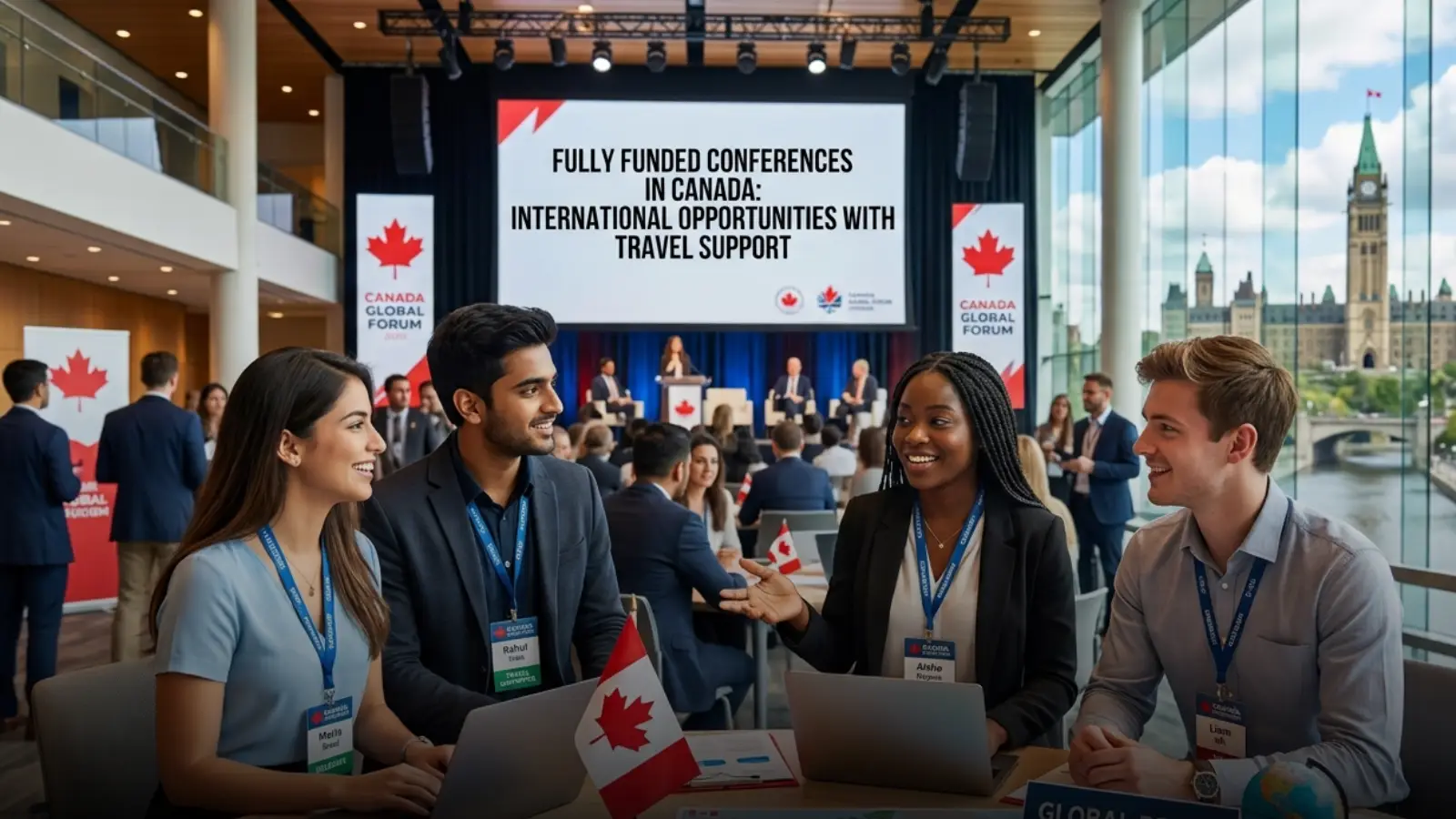
Attending a conference in Canada can help students, researchers, academics, and professionals gain knowledge, present their work, and build international connections. However, airfare, registration, accommodation, and other travel costs can be expensive. Fully funded conferences in Canada offer eligible participants financial support through travel grants, scholarships, registration waivers, accommodation, and other funding.
Below covers international conference opportunities in Canada, available travel support, eligibility requirements, application steps, and key funding options to help you attend with lower out-of-pocket costs.
What Are Fully Funded Conferences in Canada?
Fully funded conferences in Canada help selected participants attend academic, research, and professional events without paying most major expenses themselves. Organizers, universities, institutions, or sponsors may cover registration fees, airfare, accommodation, meals, local transportation, or visa-related costs. Each conference offers different benefits, so participants should check the funding conditions before applying.
Travel support helps participants manage the cost of traveling to and attending a conference. Organizers may provide airfare, accommodation, local transport, or a fixed travel grant. A fully funded opportunity usually covers most major expenses, while a partially funded opportunity covers only specific costs. These opportunities benefit students, researchers, academics, professionals, and international participants by helping them present their work, gain knowledge, build professional networks, and attend conferences with lower financial costs.
Also Read: How to Get a Visa to Attend Conferences in Canada?
What Does Travel Support for Conferences in Canada Cover?
Travel support for conferences in Canada helps participants cover the main costs of attending an event. Depending on the funding program, it may include:
- International airfare: Covers flights or approved transportation to Canada.
- Registration fees: Pays the conference participation or registration charges.
- Accommodation: Covers hotel or other approved lodging during the event.
- Meals and allowances: Provides meals or a daily allowance for basic expenses.
- Local transportation: May cover airport transfers, public transport, or travel to the venue.
- Visa expenses: Some programs support eligible Canadian visa or application fees.
- Travel insurance: Certain programs may cover insurance and other approved travel costs.
The exact coverage varies by conference, so applicants should check the funding guidelines before applying.
Who Can Attend Fully Funded Conferences in Canada?
Fully funded conferences in Canada welcome participants from different academic and professional backgrounds. Eligibility depends on the specific conference and funding program.
- International Students: They can gain international exposure, attend expert sessions, and connect with researchers and professionals from different countries.
- Undergraduate and Master’s Students: They can learn about new developments in their field, present projects, and build valuable academic connections.
- PhD Students and Doctoral Researchers: They can present research papers, receive expert feedback, and explore potential research collaborations.
- Postdoctoral Researchers: They can share their findings, strengthen their academic profile, and connect with researchers working in similar fields.
- Academics and Faculty Members: They can present research, participate in discussions, and develop international academic partnerships.
- Early-Career Researchers: They can gain visibility, improve their professional network, and discover future research or funding opportunities.
- Professionals and Industry Participants: They can explore industry trends, exchange knowledge, and connect with potential business or professional partners.
Applicants should always check the specific eligibility criteria, funding coverage, and application requirements before applying.
Fully Funded Conferences in Canada for International Students
International students can explore Canadian conferences that provide travel grants, registration waivers, student awards, and other financial support. Here are some notable options:
1. CAG2026 – Canadian Association on Gerontology
CAG2026 brings together researchers, students, healthcare professionals, and practitioners to discuss aging and gerontology. It offers student travel support to help eligible participants attend and present their research.
- Funding: Full student registration + partial travel support
- Eligibility: Current student members
- Requirement: Accepted abstract and presenting-author status
- Best for: Gerontology, aging, health, and social research
2. CEA2026 – Canadian Economics Association Conference
CEA2026 provides a platform for economists and researchers to present academic work and discuss developments in economics. Eligible students can apply for financial assistance to reduce conference travel costs.
- Funding: Up to CAD 1,250
- Covers: Travel, accommodation, and food expenses
- Eligibility: Eligible graduate students
- Requirement: Paper submission or presentation
- Best for: Economics and related research
3. SSC 2026 Annual Meeting – Statistical Society of Canada
This annual meeting connects statisticians, researchers, students, and professionals to share developments in statistics and data-related fields. Student travel grants can help eligible presenters manage the cost of attending.
- Funding: Up to CAD 750
- Eligibility: Full-time students
- Requirement: Poster or oral presentation
- Best for: Statistics, data science, and mathematics
4. IAPB2026 – International Association for Plant Biotechnology Congress
IAPB2026 focuses on plant biotechnology and brings together researchers, students, and professionals from around the world. Student awards support young researchers who present their work at the congress.
- Funding: Student awards of up to CAD 500
- Eligibility: Undergraduate, master’s, doctoral, and technical-college students
- Requirement: Accepted oral or poster abstract
- Best for: Plant biotechnology and agricultural research
5. CPSA 2026 Annual Conference – Canadian Political Science Association
CPSA’s annual conference brings political scientists and researchers together to present research and discuss major developments in political science. Travel grants can help eligible early-career researchers participate in the conference.
- Funding: Up to CAD 500
- Eligibility: Eligible PhD students, postdoctoral researchers, and recent PhD graduates
- Requirement: Paper, poster, or Three-Minute Thesis presentation
- Best for: Political science and social sciences
How to Apply for a fully funded conference in Canada
Applying for a fully funded conference in Canada requires careful planning because funding programs often have separate eligibility criteria, application deadlines, and documentation requirements. Follow these steps to improve your chances of receiving financial support.
Step 1: Find an Eligible Conference
Choose a conference related to your study, research, or profession and check whether it offers travel grants, scholarships, or registration support.
Step 2: Check the Travel Funding Requirements
Review the eligibility criteria, funding coverage, presentation requirements, and deadlines before applying.
Step 3: Submit Your Abstract or Research Paper
Submit your abstract, paper, poster, or presentation proposal according to the conference guidelines and deadline.
Step 4: Receive Conference Acceptance
Wait for the acceptance decision and keep your official acceptance letter, as funding programs often require it.
Step 5: Prepare Your Funding Application
Submit the required documents, such as your CV, acceptance letter, research details, proof of enrollment, and motivation statement.
Step 6: Submit a Detailed Travel Budget
List expected costs for airfare, accommodation, registration, meals, transportation, and visa expenses according to the funding rules.
Step 7: Apply Before the Funding Deadline
Submit your application before the deadline and check that all required documents are complete.
Step 8: Complete Post-Conference Reimbursement Requirements
Keep all tickets, invoices, and receipts and submit them after the conference if the program requires reimbursement.
Documents Required to Apply for Conference Travel Support
Applicants should prepare the right documents before applying for conference travel support, as funding programs use them to verify eligibility, conference participation, academic background, and estimated travel costs. The commonly required documents include:
- Conference Acceptance Letter: Confirms that your paper, poster, or presentation has been accepted.
- Abstract or Research Paper: Provides details about the research or work you will present.
- CV or Resume: Highlights your education, research experience, publications, achievements, and professional background.
- Academic Transcript: Shows your academic record and may help verify your eligibility.
- Proof of Student/Researcher Status: Includes a student ID, enrollment letter, or official university certificate.
- Recommendation Letter: A letter from a professor or supervisor supporting your conference participation.
- Travel Itinerary: Shows your planned flight dates, arrival, departure, and transportation details.
- Estimated Travel Expenses: Lists expected costs for flights, accommodation, meals, and local transportation.
- Proof of Registration: Confirms your registration or participation in the conference.
Common Reasons Conference Travel Funding Applications Are Rejected
Conference travel funding programs receive many applications, so even eligible applicants can face rejection if they miss important requirements. Understanding common mistakes can help you prepare a stronger application.
- Applying After the Deadline: Late applications usually do not qualify for consideration.
- Missing Documents: Incomplete applications may be rejected if required documents are missing.
- Ineligible Conference: The conference may not meet the funding program’s eligibility criteria.
- No Accepted Presentation: Some grants require an accepted paper, poster, or presentation.
- Incomplete Budget: Applicants should provide a clear estimate of travel and accommodation costs.
- Ineligible Expenses: Personal, luxury, or non-approved expenses may not qualify for funding.
- Eligibility Issues: Applicants must meet required citizenship, student, academic, or membership conditions.
- Weak Relevance Statement: Clearly explain how the conference supports your research, education, or career goals.
By checking eligibility requirements, preparing the required documents, and applying before deadlines, students, researchers, and international participants can improve their chances of receiving valuable conference travel support.